

In a strong seller’s market, like the one we have experienced over the past few years, bidding wars are common and expected. This makes sense! A seller’s market is defined as a market in which the inventory of homes for sale cannot satisfy the number of buyers who want to purchase a home.
According to the Cambridge English Dictionary, bidding wars occur when two or more parties repeatedly outbid each other as they compete to purchase something- in this case, a home.
In some areas of the country, first-time buyers have been met with fierce competition throughout their experience. Some have been out-bid multiple times before finally winning a bid on a home to call their own.
According to the latest Existing Home Sales Report from the National Association of Realtors (NAR), there is currently a 3.7-month supply of homes for sale.
With the current number of houses listed for sale and the level of demand from buyers, this means it would take 3.7 months for all the homes listed to sell if no additional listings came to market. Any supply number under a 6-month supply is considered a seller’s market. According to NAR, the housing market hasn’t had a 6-month supply of homes for sale since August 2012.
Good News for Buyers
A recent report shows that the percentage of houses sold including a bidding war before settling on a final price decreased from 53% in January of 2018 to 13% this year.
One reason for the decline is an influx of homes being listed for sale. Even though the month’s supply number is not increasing, the number of homes for sale is. The chart below shows the year-over-year change in inventory over the last 12 months.
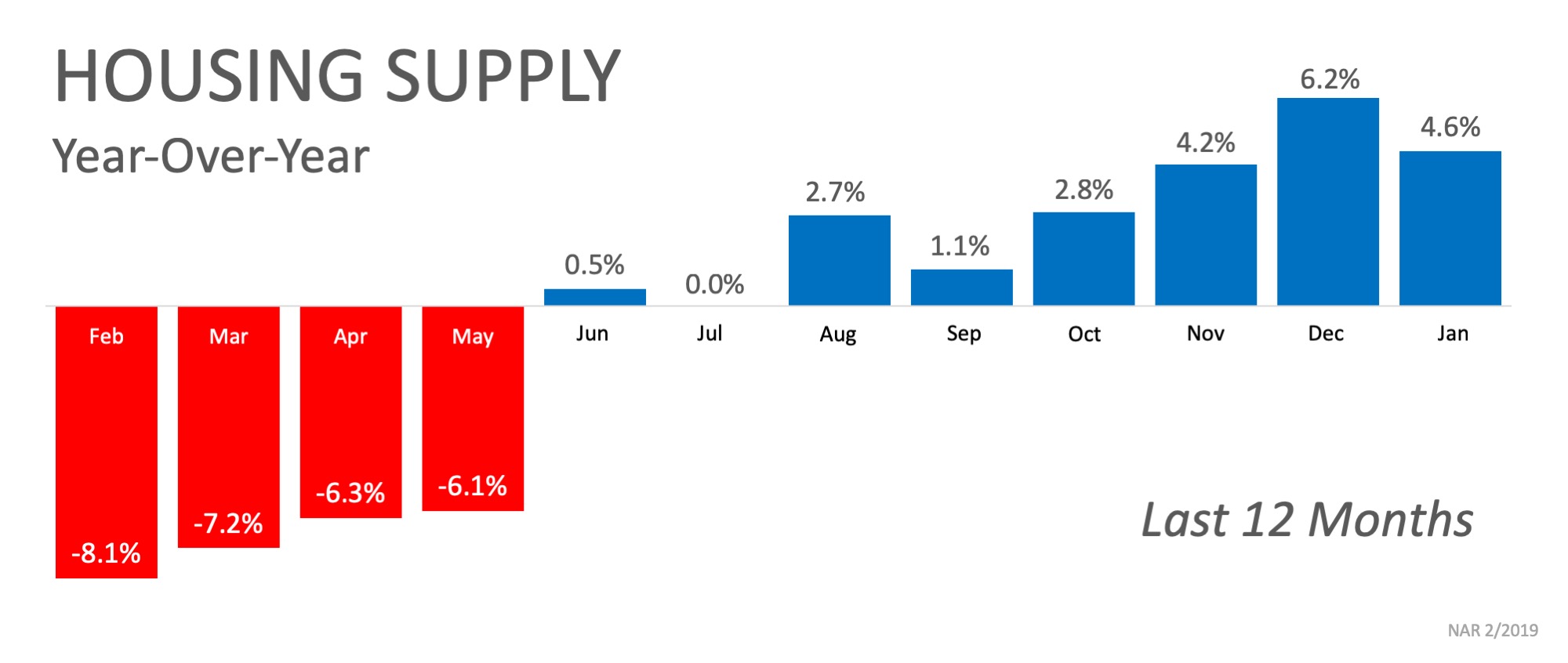
As you can see, the number of homes for sale has started to build over the last eight months. Prior to this reversal, inventory levels had fallen for 36 consecutive months when compared to the year before.
Danielle Hale, realtor.com’s Chief Economist, gave some insight into why bidding wars are less common on a local level this year,
“[Last year] you might have been the only listing in your neighborhood, and you could put your home up at a certain list price and you would likely see multiple offers at or above that list price. That tide is turning this year.
It’s going to depend on what neighborhood you’re in, but we expect it to be more common this year that you won’t be the only listing.”
Inventory in the luxury and premium markets (the top 25% of listings in an area by price), is increasing at a greater rate than the starter home market. As the choices buyers have continued to increase, the likelihood of a bidding war will decrease.
Bottom Line
If you are debating listing your house for sale this year, you may not want to wait for additional competition as inventory continues to rise.


 The data relating to real estate for sale on this web site comes in part from the Broker Reciprocity Program of the Regional Multiple Listing Service of Minnesota, Inc. Real estate listings held by brokerage firms other than REMAX Advantage Plus - Shakopee are marked with the Broker Reciprocity logo or the Broker Reciprocity thumbnail logo (little black
house) and detailed information about them includes the name of the listing brokers.
The data relating to real estate for sale on this web site comes in part from the Broker Reciprocity Program of the Regional Multiple Listing Service of Minnesota, Inc. Real estate listings held by brokerage firms other than REMAX Advantage Plus - Shakopee are marked with the Broker Reciprocity logo or the Broker Reciprocity thumbnail logo (little black
house) and detailed information about them includes the name of the listing brokers.
 © 2026 Realtor Association of Southern Minnesota. All rights reserved. The data relating to real estate for sale on this limited electronic display comes in part from the Broker Reciprocity (sm) Program of the Realtor Association of Southern Minnesota Multiple Listing Service. Real estate listings held by brokerage firms other then REMAX Advantage Plus - Shakopee are marked with the Broker Reciprocity(sm) logo or the Broker Reciprocity(sm) thumbnail logo (a little black house) and detailed
 Information should be deemed reliable but not guaranteed, all representations are approximate, and individual verification is recommended. Copyright ©2017 All rights reserved.
